An electronic timer is the single best upgrade you can make to a pinewood derby — it turns every disputed photo finish into an instant, indisputable result. Here’s how to choose one.
Why you need an electronic timer
Pinewood derby cars reach scale speeds well over 200 mph and cross the finish line fractions of a second apart. Judging that by eye is a recipe for ties, mistakes, tears, and arguments between parents. An electronic timer removes all of it: it records the exact finish order and elapsed time and displays the result instantly, so no child ever loses a race to a judging error. For any organized race — a pack, a church, a school, a district — it isn’t a luxury, it’s what makes the day fair.
How electronic timers work
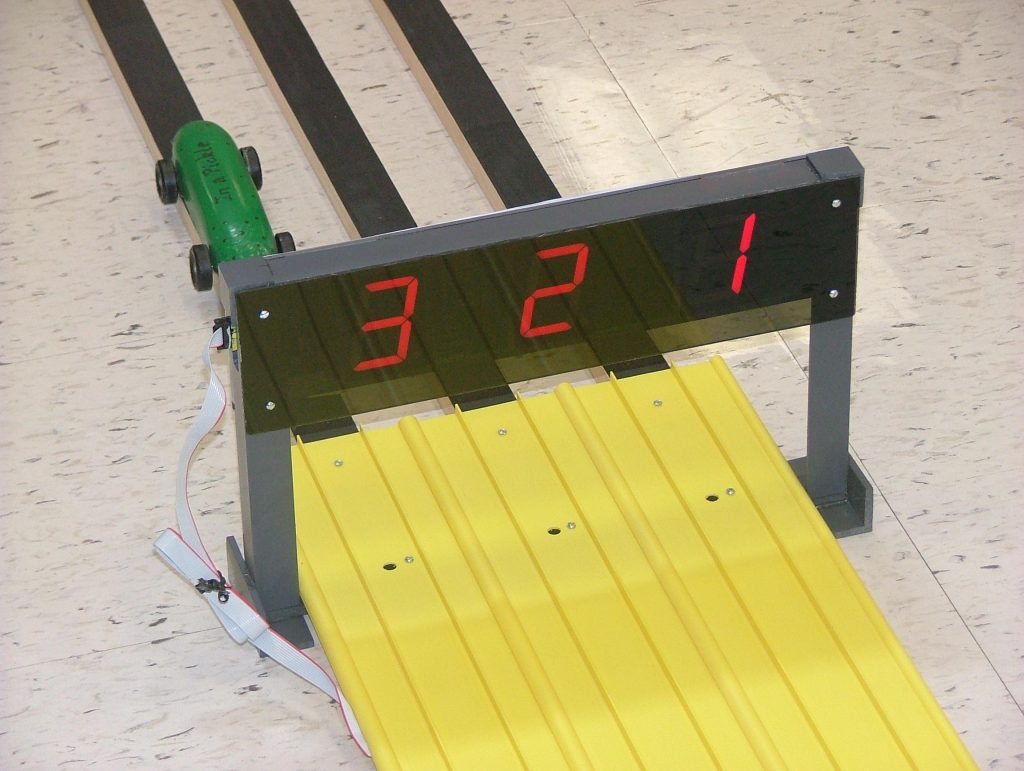
A finish-line timer uses optical sensors — one per lane — mounted at the end of the track. As each car breaks its lane’s beam, the timer records that lane’s finish order and elapsed time, down to the thousandth of a second, and shows it on a bright display. Many timers also connect to a laptop so the times flow straight into race software.

What to look for
- Accuracy. Look for thousandth-of-a-second resolution — enough to separate any photo finish.
- Lane match. A timer and finish line are built for a specific number of lanes, so match it to your track.
- Connectivity. Wireless removes the cable run from the finish to your scoring table; USB is a simple wired link. Having both is ideal.
- Software compatibility. The timer should feed your race software directly, so results post automatically.
- Display. Bright, readable, and — for bigger crowds — visible from both sides (see below).
- Reliability & support. On race morning you want equipment that just works, from a company that answers the phone.
Single-sided vs. double-sided
A single-sided display faces one direction — fine for smaller rooms. A double-sided display shows the finish order and times to the racers and the audience at the same time, which is a big win at larger events where families watch from both sides of the finish line.

Finish line and light tree
The timer is part of the finish line itself. Many groups add a light tree — the traffic-light-style start signal — for a countdown the racers can see, plus a clear visual cue at the finish. It adds polish and keeps heats moving on cue.
Derby Magic timers
We build our timers to pair with our tracks and software out of the box. The lineup includes single- and double-sided models (our SOF and ET timers and a double-sided option), plus a lower-cost timer, all with wireless and USB connectivity. Because we make the track, the timer, and the software, they’re designed to work together — no mixing three vendors and hoping they talk to each other. See current models and pricing on our pricing page.

Do you also need software?
The timer captures the result; race-management software is what schedules the heats, rotates every car through every lane for fairness, and posts the standings automatically. The two work as a pair — the timer feeds the software, and the software runs your day.
Quick buyer’s checklist
- Thousandth-of-a-second accuracy
- Built for your track’s lane count
- Wireless and/or USB to your laptop
- Feeds your race software directly
- Readable display (double-sided for big crowds)
- From a maker who’ll support you on race day
Frequently Asked Questions
Do you really need an electronic timer?
For any organized race, yes. Cars cross the finish line fractions of a second apart, so judging by eye leads to ties, mistakes, and arguments. An electronic timer records the order and elapsed time to the thousandth of a second and shows it instantly, so every result is fair and final.
How accurate are pinewood derby timers?
A good electronic timer records to the thousandth of a second using optical sensors at the finish line — far beyond what the eye can judge, and enough to separate even photo finishes.
How many lanes can a timer handle?
Match the timer to your track — a timer and finish line are built for a specific number of lanes. Derby Magic timers are made to match our 1-to-8-lane tracks, so the timer, track, and software all line up.
Should I get a wireless or USB timer?
Both work well. USB is a simple, reliable wired link to a laptop; wireless removes the cable run from the finish line to your scoring table. Derby Magic timers support both.
What’s the difference between single-sided and double-sided?
A single-sided display faces one direction; a double-sided display shows the finish order and times to both the racers and the audience at once — popular for bigger events.
Do I need race software too?
The timer captures the results; race software schedules the heats, rotates every car through every lane, and posts standings automatically. They work together.