An electronic timer looks like magic on race day — cars blur across the line and exact times appear instantly. There’s no magic to it, though: just a start switch, a light sensor over every lane, and a very fast clock. Here’s exactly how those pieces turn a four-car blur into a fair, final result.

The problem a timer solves
Pinewood derby cars reach scale speeds well over 200 mph and cross the finish line fractions of a second apart. No human eye can reliably call which of four, six, or eight cars got there first — which is why visual judging produces ties, do-overs, and second-guessing. An electronic timer removes the guesswork entirely, and it does it the same way in every heat, so the hundredth race of the day is judged exactly like the first.
What’s inside a derby timer
For all the precision in the result, the hardware is refreshingly simple. Four parts do the work:
- A start switch at the gate that tells the timer the instant the cars are released.
- A finish sensor for every lane — a small optical (infrared) beam the car breaks as it crosses the line.
- A precision clock and microcontroller that measures the gap between start and finish to the thousandth of a second.
- A display and a connection — the result shown on the timer itself, plus a wireless or USB link to a laptop.
There are no moving parts in the sensing. Nothing drags, wears, or drifts out of adjustment from one race to the next, which is a big part of why an electronic timer is so consistent.
How it works, step by step
- The clock starts at the gate. When the start gate releases, a switch tells the timer “go,” and the clock begins for every lane at the same instant.
- Each lane has its own finish sensor. At the finish line, every lane has an optical sensor — a small light beam. The cars run down the track toward it.
- The car trips the beam. As a car crosses the finish, it interrupts its lane’s light beam. The timer marks that exact moment as that car’s finish.
- It records order and time. Because each lane is measured independently, the timer knows both the order cars finished and each car’s elapsed time, down to the thousandth of a second.
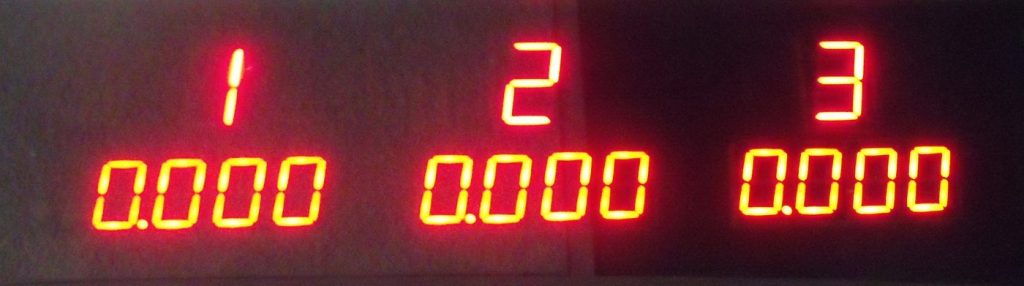
- It shows and sends the result. The times appear instantly on the display, and the timer can send them straight to race software over wireless or USB.
The start: how the clock knows to go
Timing begins at the start gate. When the gate releases — whether it’s dropped by hand, by a solenoid, or by a wireless signal — a switch tells the timer to start counting, for every lane at the same instant. That simultaneous start is what makes a lane-to-lane comparison fair: every car’s clock begins at exactly the same moment, so the only thing that differs is how fast the car actually runs. Tie the start and the clock together and a close race comes down to the cars; leave them loose and a fraction-of-a-second delay could decide it instead.
The finish: how each lane is caught
At the other end, each lane has its own sensor watching for its own car. As a car reaches the finish, it passes through a beam of light focused on that lane; the instant the beam is broken, the timer stamps that car’s finish. Because the lanes are measured independently, it doesn’t matter whether the cars arrive in a tight pack or strung out down the track — the timer catches each one on its own, ranks the whole heat, and gives every car an exact elapsed time. Quality timers are built so ordinary gym and room lighting won’t fool the sensors, so you get the same clean read in a bright cafeteria or a dim fellowship hall.
Why thousandth-second accuracy matters
Three decimal places sounds like overkill until you watch a photo finish. Two cars can cross so close that the display reads, say, 2.998 and 3.001 — a result the eye would call a tie but the timer calls cleanly. That precision is exactly what keeps a close race fair, and it’s what lets you rank an entire field by time rather than by argument.
From the timer to your screen
On its own, a timer will show each lane’s place and time right on its display — enough to run a simple, casual race. The real time-saver is sending those numbers straight to a laptop. Derby Magic timers connect by wireless or USB and feed results directly into race software, so no one is squinting at a display and retyping times into a spreadsheet. The software takes the stream of times, builds the heat schedule, rotates every car through every lane, keeps the running standings, and prints the results — all from the numbers the timer hands it. A double-sided timer even shows the result to the racers on one side and the crowd on the other at the same time.
What makes one timer better than another
If the basic idea is the same everywhere, what separates a good timer from a frustrating one? A sensor for every lane, so you time the whole heat at once instead of running cars through one or two lanes at a time; consistent sensing that isn’t thrown off by room lighting; a rock-solid connection to your laptop; and a timer matched to your track and finish line so everything lines up. Because Derby Magic builds the track, the timer, and the software together, those pieces are designed to fit — the gate starts the clock, the sensors stop it, and the software does the rest, with nothing to make compatible. The timer buying guide walks through the specific models and which fits your race.
Frequently Asked Questions
How does a pinewood derby timer work?
The clock starts when the start gate releases and stops for each lane when the car breaks an optical sensor at the finish. The timer records each lane’s order and elapsed time to the thousandth of a second and shows it instantly, then can send it to race software over wireless or USB.
What kind of sensor does it use?
Almost all electronic derby timers use an optical sensor — an infrared light beam — over each lane. The car breaks the beam as it crosses, marking its finish. There are no moving parts, so there’s nothing to wear out between races.
How do the finish-line sensors detect the car?
Each lane has its own optical sensor at the finish. As the car passes, it interrupts the light to that sensor, marking its finish. Because every lane has one, the timer can rank all the cars in a heat and give each an exact time.
How accurate are they?
To the thousandth of a second — far finer than the eye can judge, so even a photo finish resolves to a clear winner.
Can you use a timer without a computer?
Yes. A timer shows each lane’s place and time right on its display, which is enough for a simple race. Connecting it to software over wireless or USB adds automatic scheduling, lane rotation, and standings, and saves you entering times by hand.
Why do you need a timer if you can watch the finish?
Cars finish fractions of a second apart, so the eye can’t call it reliably, which leads to ties and disputes. A timer removes all judgment from the result.